Burrowing owls, gopher tortoises and clearing a Cape Coral lot
Cape Coral has more than a thousand nesting pairs of burrowing owls — the most in Florida — and they live on exactly the open, mowed lots people are about to build on. Here's what the law says and how a clearing job goes when it's done right.
The owls
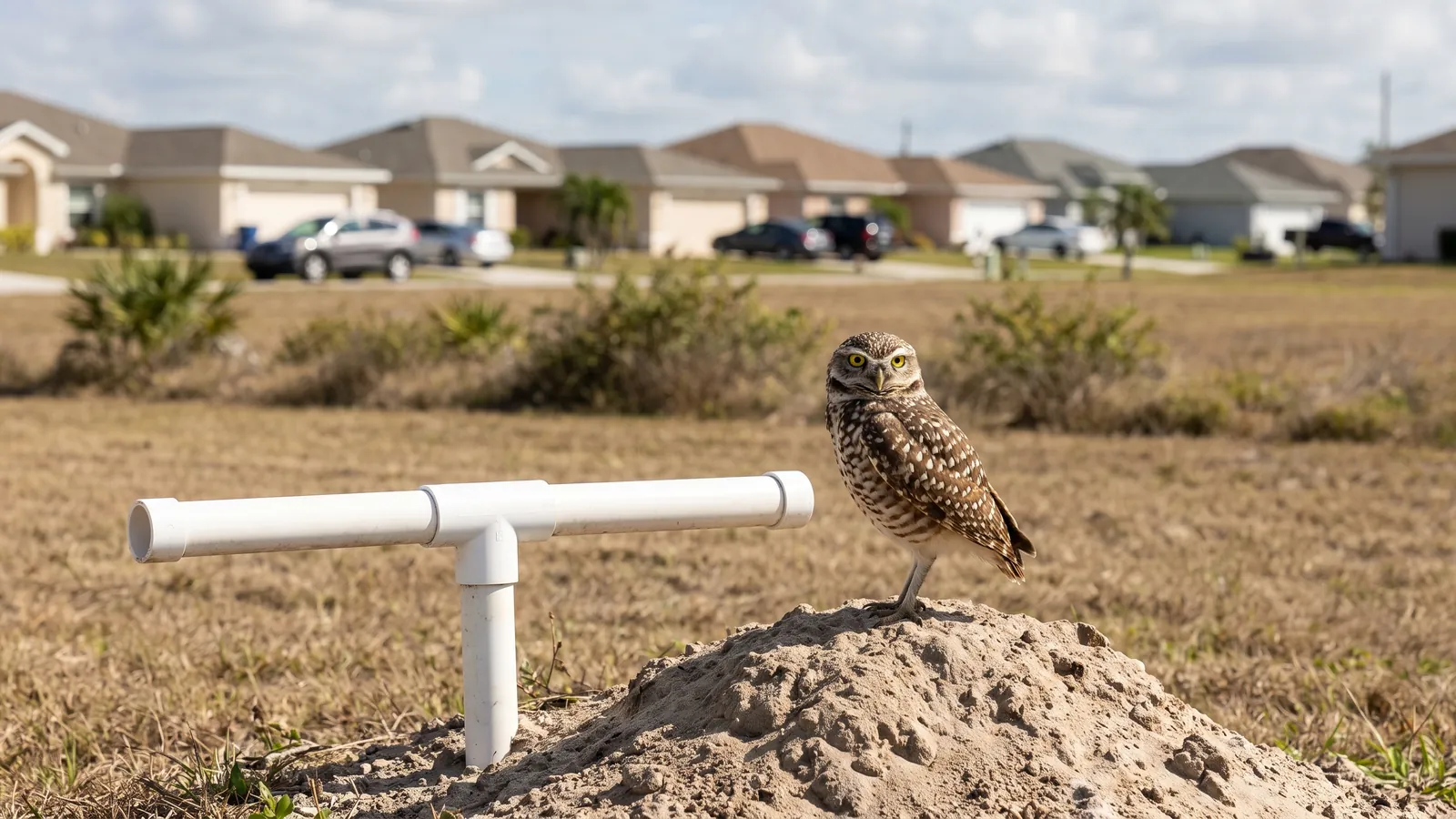
Florida burrowing owls are nine-inch, long-legged, yellow-eyed owls that nest in the ground, and Cape Coral is their capital: more than a thousand nesting pairs, the largest population in the state, concentrated on the city's tens of thousands of vacant lots, especially in the North Cape. They're a state-threatened species, the city's official bird, and the subject of the Cape Coral Friends of Wildlife's annual Burrowing Owl Festival every February. You'll know a burrow by the sandy mound with a hole the size of a grapefruit, often with a white PVC T-perch that volunteers install nearby, and usually by the owl itself standing beside it.
The rules
- Buffer: nothing — no mowing, clearing, grading, digging, stump grinding, parking or driving — within 10 feet of an active burrow entrance year-round.
- Nesting season: February 15 to July 10, the buffer grows to 33 feet. Peak nesting in Cape Coral is mid-March; young are flying at about six weeks but may stay near the nest into August.
- If the burrow is in the way: the owner applies to the Florida Fish and Wildlife Conservation Commission for an incidental take permit. FWC issues them only as a last resort, after reasonable alternatives have been considered, with a mitigation contribution (set per burrow or per cluster, in the hundreds to about $1,900), and the city strongly encourages installing a starter burrow elsewhere on the property so the owls have somewhere to go.
- Penalties: harming an owl, its eggs or its burrow violates state law, and Cape Coral's ordinance adds a $500 fine or up to 60 days. FWC's Wildlife Alert line is 888-404-3922; the city's planning division (239-573-3077) keeps the burrow map and takes reports of new burrows.
The tortoises
Gopher tortoises dig their burrows in the same dry, sandy ground — a half-moon-shaped hole with an apron of sand in front — and they're also state-threatened. The buffer is 25 feet of no disturbance. If a burrow can't be avoided, the tortoise is relocated under an FWC permit (the "10 or fewer burrows" permit for a house lot) by an FWC-authorized gopher tortoise agent, before any clearing. A relocation typically runs $500 to $1,500 per animal plus the survey. We don't relocate tortoises; we find and flag the burrows and refer you to an agent.
The eagles
Cape Coral has its own bald eagle ordinance: an eagle nest management zone of 1,100 feet, in which heavy construction can be barred within 350 feet of the nest during nesting season, October 1 to May 15. It applies in the plat units that have nests — the city publishes which. Clearing a lot inside a zone is a conversation with the city's planning staff before anything is scheduled.
How clearing actually goes
- The walk. Before a machine is scheduled, we walk the whole lot and the edges of the neighbors' lots, find every burrow, flag it, and stake the buffer distance. If it's nesting season, that's the 33-foot circle.
- The plan. The clearing plan is drawn around the buffers. If a burrow sits in the house footprint, we tell you now, not on the day — and we explain the FWC application, which is the owner's to file.
- The trees. Slash pines are felled or sectioned away from the burrows, saw palmetto and Brazilian pepper are grubbed, melaleuca stumps are treated so they don't resprout. The native trees the lot will need at its certificate of occupancy — a healthy pine or oak that fits the site plan — are kept where we can, because they count toward the city's required-tree list and save planting one.
- The haul. A vacant lot gets no curbside pickup, so everything is chipped and hauled or ground on site. The lot is left to the site plan with the burrow buffers still staked for the surveyor and the pad crew.
The city's side
Cape Coral's lot-mowing program mows every unimproved lot thirteen times a year (and assesses owners for it — roughly $90 to $140 a year for a standard two-unit lot in 2026), which is what keeps the lots open enough for owls in the first place. When you build, clearing is covered under the building permit; clearing a lot with no construction planned is treated differently, so tell us what you're doing and when. Code compliance expects grass under twelve inches and lots free of fallen limbs and debris.
Common questions
How do I know if a burrow is active?
Fresh sand at the entrance, tracks, droppings and feathers, or the owl standing next to it. An abandoned burrow can still be protected if it's in use by another owl; the city's planning division and the Friends of Wildlife can confirm status, and FWC decides.
Can I just mow around it myself?
Yes — the city encourages owners to maintain lots around burrows, outside the buffer. Keep the mower 10 feet away (33 in season) and leave the perch alone.
What does an FWC permit cost and how long does it take?
The mitigation contribution runs from nothing to about $1,900 per burrow or cluster depending on the situation, and the application takes weeks; outside nesting season it moves faster. Plan the clearing around it rather than hoping the owls leave.
Do you charge for the burrow survey?
No. Flagging and buffer staking are part of every lot-clearing estimate.
Related: Vacant lot clearing · Northwest Cape Coral · Permit guide · Stump grinding