The record
- Charley — August 13, 2004Category 4 landfall at Cayo Costa at 150 mph, second landfall at Punta Gorda; Punta Gorda gusted to about 112, Cape Coral unofficially to 90. The Australian pine windbreaks along the Cape's canals went over in rows. $15 billion in US damage.
- Wilma — October 24, 2005Category 3 across the south; hurricane-force gusts in Lee County, hundreds of trees uprooted, 208,000 LCEC customers in the dark. The Cape's "hurricane-cut" palms snapped at the bud.
- Irma — September 10, 2017Marco Island landfall at 115 mph; about half of Cape Coral lost power, LCEC had 190,000 customers restored within eight days. Over-topped ficus and black olives failed across the south Cape.
- Ian — September 28, 2022Cayo Costa at 150 mph, then Punta Gorda. 140-mph gust at the Cape Coral Yacht Club, 109 at Tarpon Point, six to nine feet of surge up the south Cape canals, fifteen feet on Fort Myers Beach, 36 of 41 Lee surge deaths, 1.9 million cubic yards of debris off Cape Coral streets by December. Rocked the slash pines that are still dying.
- Helene — September 26, 2024Passed offshore; 55–65-mph gusts and a five-foot tide at Fort Myers. Finished off trees Ian had weakened.
- Milton — October 9, 202470–80-mph gusts across Lee, an EF-2 tornado in Fort Myers and an EF-1 in Matlacha, the second-highest water on record at Fort Myers, 80,000 Cape Coral outages, another 50,000–100,000 cubic yards of debris.
What fails, every time
University of Florida surveyed tree damage after every one of these storms and found the same pattern. The trees that failed: Australian pine and melaleuca first, always — tall, brittle and shallow-rooted; then ficus, black olive and other over-topped or lion-tailed shade trees with regrown mops of weak sprouts; then slash pines rocked in saturated ground; then over-pruned palms with their crowns stripped to a few upright fronds, which snapped at the bud; Norfolk Island pines and queen palms with Ganoderma. The trees that stood: live oaks, sabal palms, gumbo limbo, seagrape, buttonwood, properly thinned mahoganies, and full-crowned royals and coconuts that bent and sprang back.
The February-to-May checklist
- Remove the trees that are going to fail anyway. Australian pines near a structure or the water, dead or declining slash pines, Ganoderma and lethal-bronzing palms, melaleuca, anything with a hollow or a crack at the base, over-topped ficus with a mop of sprouts. These are the trees on roofs after every storm, and they're far cheaper to remove in March than to get off a lanai in October.
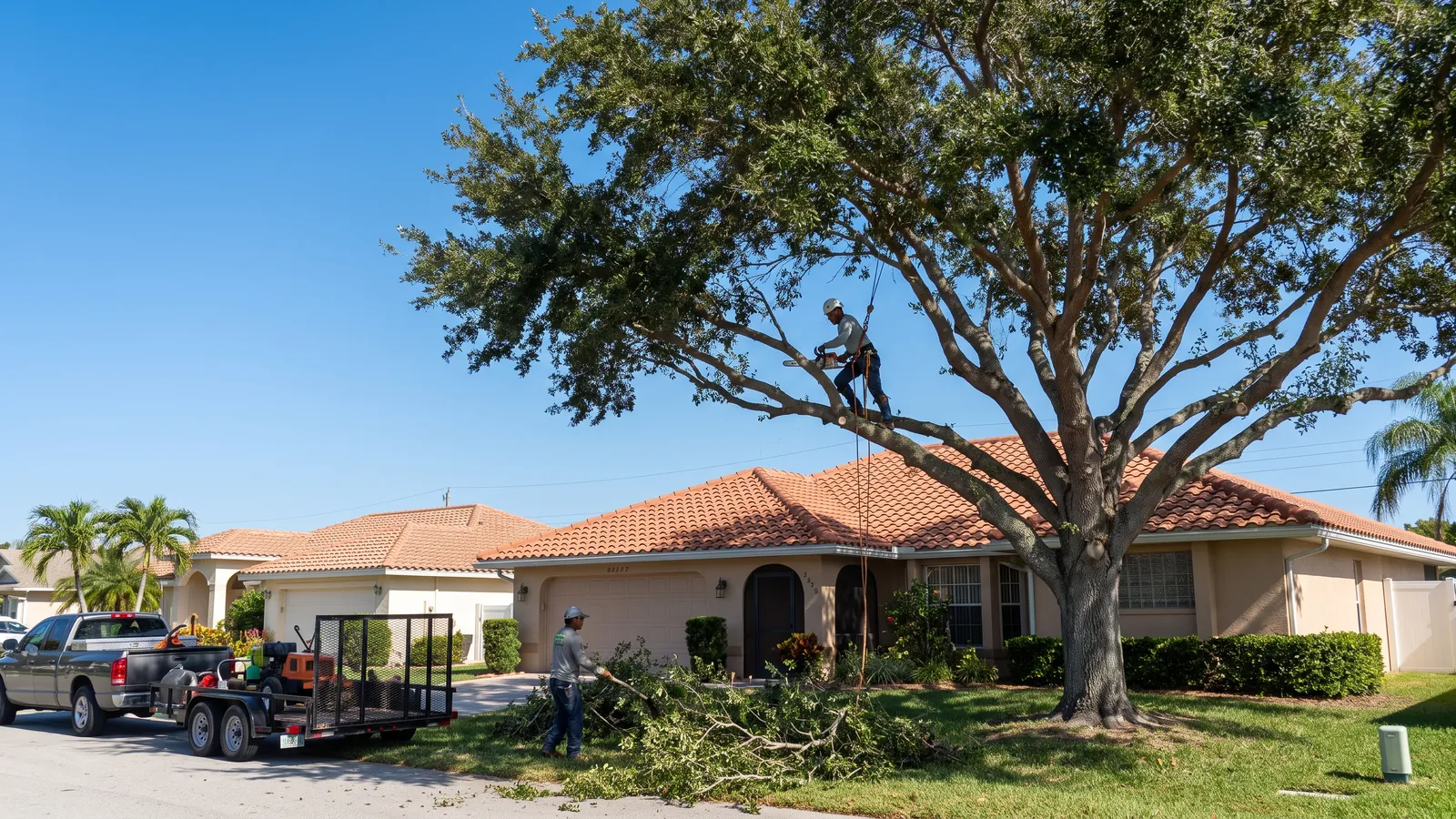
- Thin the big shade trees. Interior thinning of ficus, black olive, mahogany and oaks so wind passes through the canopy instead of pushing on it. ANSI A300 cuts, never more than a quarter of the live crown. Not topping — topping is what makes the next failure.
- Take the weight off the roof and the cage. Limbs over the house, the lanai and the pool cage reduced back to a strong lateral.
- Clean the palms — and only clean them. Dead fronds, seed stalks, coconuts and the heavy royal fronds come down. The green crown stays. No hurricane cut.
- Clear the service drop. Seven feet from the LCEC drop, so the first gust doesn't take your power; the utility handles the primaries.
- Check the storm survivors. Trees that stood through Ian and Milton often have cracked unions, lifted root plates and decay that doesn't show for a year or two. The arborist sounds the trunk and looks at the root flare.
- Know the debris rules. After a declared storm: four separate curbside piles, vegetation in its own, clear of hydrants, mailboxes and lines, in claw-truck-sized piles. Outside a declared collection the city won't take tree-company debris — we haul.
Why not the hurricane cut
Every spring someone offers to "hurricane-cut" the palms — strip them to a few upright fronds so they "catch less wind." It doesn't work and it does harm. Palms are built to bend; a full crown protects the bud, stores the palm's nutrients and keeps the trunk strong. A stripped palm grows a narrow pencil-neck, starves, opens itself to disease, and snaps at the bud in exactly the storm it was supposedly prepared for. UF's post-storm surveys found over-pruned palms failing where full ones stood. The same goes for hat-racking shade trees: the flat-topped ficus regrows a mop of weakly attached sprouts that comes apart in the next storm. The islands prohibit it outright. We don't do either.
Common questions
When should I schedule hurricane prep?
February through May. The season starts June 1 and the serious part is August to October. Cuts need a few months to close, and we're booked solid by June.
Does trimming help at 140 mph?
In the eyewall of a Category 4, little survives. But most of a hurricane's footprint is 60 to 100 mph, and at those speeds a thinned tree stands and a dense, over-weighted one goes over. Ian's damage across the Cape was overwhelmingly the same few species and the same pruning mistakes.
Which trees should I plant after a removal?
Natives that stood: live oak, sabal palm, gumbo limbo, seagrape, buttonwood, dahoon holly, and in the right spot a mahogany kept thinned. Not Australian pine, not ficus near anything, not a queen palm where a Ganoderma palm died.
Will my insurance pay for prep?
No. Preventive pruning and removing a standing tree are never covered. Removing a tree from a structure after a storm is, as part of the loss, less the hurricane deductible — which is why $1,800 of prep in March is the better deal than a $7,500 deductible in October.
Related: Hurricane tree prep service · Storm cleanup · Emergency service · Pines dying after Ian